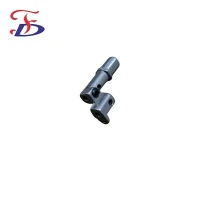
The working principle of the rotary hook is usually after the needle rises a certain distance, the tip of the rotary hook bed starts to hook into the thread loop, and the hook tip hooks the thread loop and continues to rotate. When the thread loop is sent to the guide rail opening of the hook frame, the thread loop is hooked by the hook of the hook frame. At this time, the needle should rise about 2 mm from the lower limit position. The thread-splitting hook on the hook rack should be close to the thread loop, so that the end of the thread loop has time to move to the back of the guide rail. The angle between the thread-splitting hook and the needle movement axis is about 50°. At the rear, one side is hooked by the thread separation hook of the shuttle frame, and slides down to the bottom of the shuttle frame. At this moment, the machine needle exits in the hook mechanism.
Because the thread passing place of the shuttle frame is very smooth, the thread loop slides out smoothly from the bottom of the frame, and when the tip of the shuttle turns 180°, the thread take-up lever rises, and the remaining part of the thread sent down before the thread take-up lever is taken up, and the hook tip hooks the thread loop and continues to rotate. The first half of the thread loop is under the thread guide plate. The second half of the thread loop is hooked by the thread separation hook of the shuttle frame, and the thread loop is separated from the front and back. Finally, the front and back of the thread loop are put on the shuttle frame, and the bottom thread is placed in the middle, and the thread loop is tightened by the thread take-up lever to form stitches.